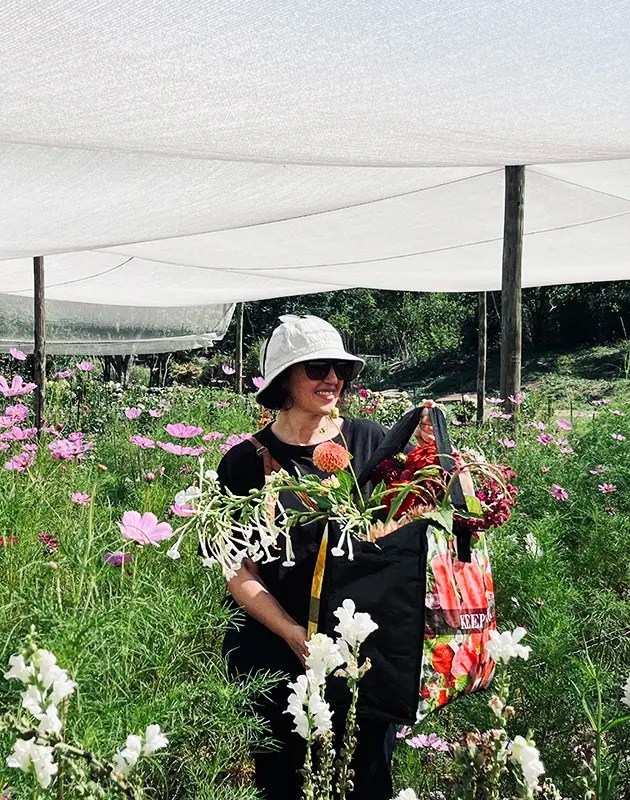
Playful, symbiotic relationships are represented in Tessa Teixeira’s work. Her practice explores existential philosophy and consciousness through the urgent lens of climate change, ecology and bio diversity loss. Inspired by the concept of “plant blindness”, our cultural tendency to overlook plants as vital beings, she challenges the way we perceive the natural world. Unlike animals plants often fade into the background, seen as a homogeneous green backdrop with ‘low signal value’, ignored despite their extraordinary intelligence and resilience. Her practice experiments with non-toxic, ecologically sustainable materials.
Seeing Green
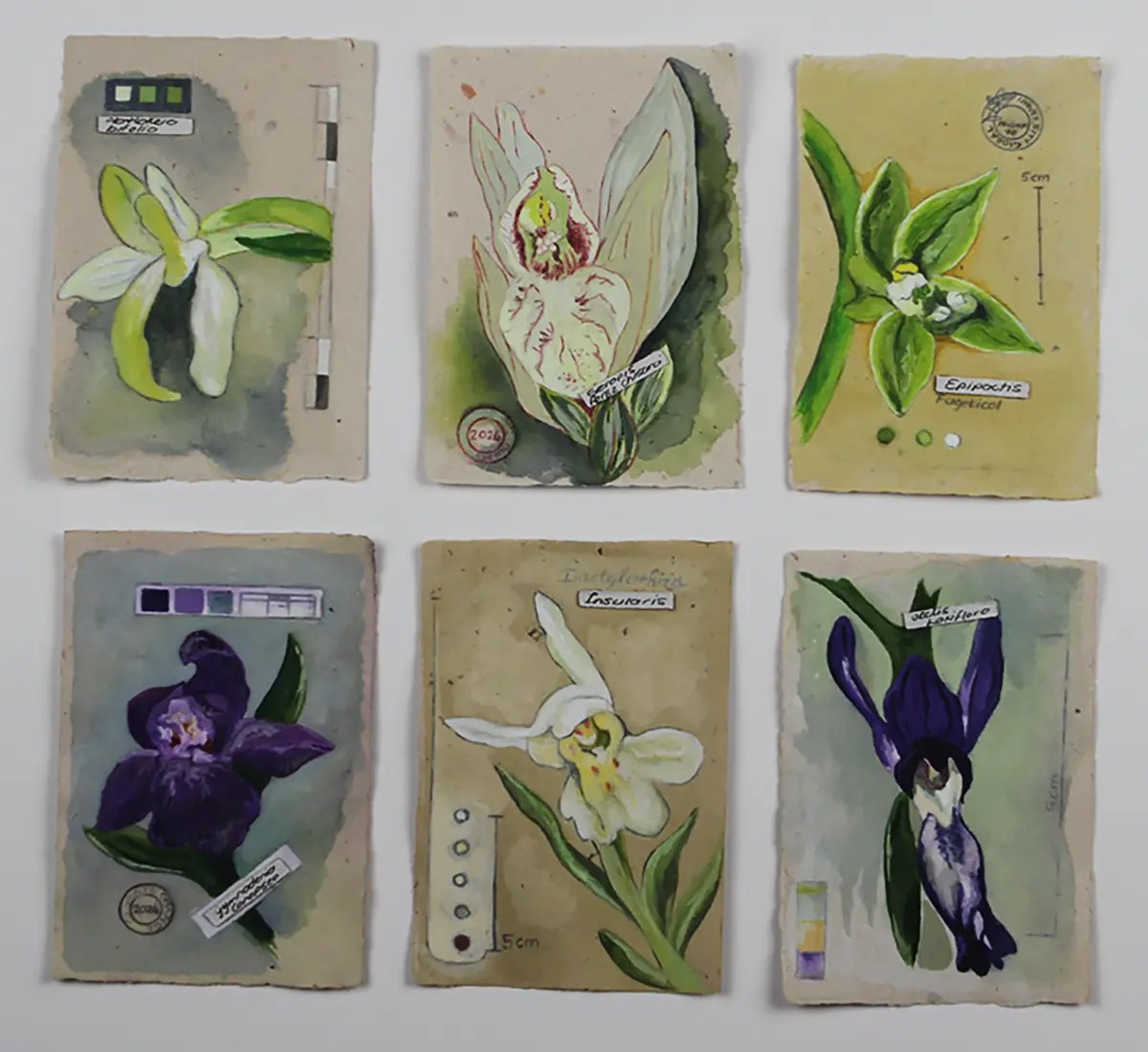
A comprehensive artist statement is published on Seeing Green Art practice website, an online space/ gallery, where you can view all the artworks for this portfolio of work. Follow the links below.
PREVIOUS STATEMENTS
-
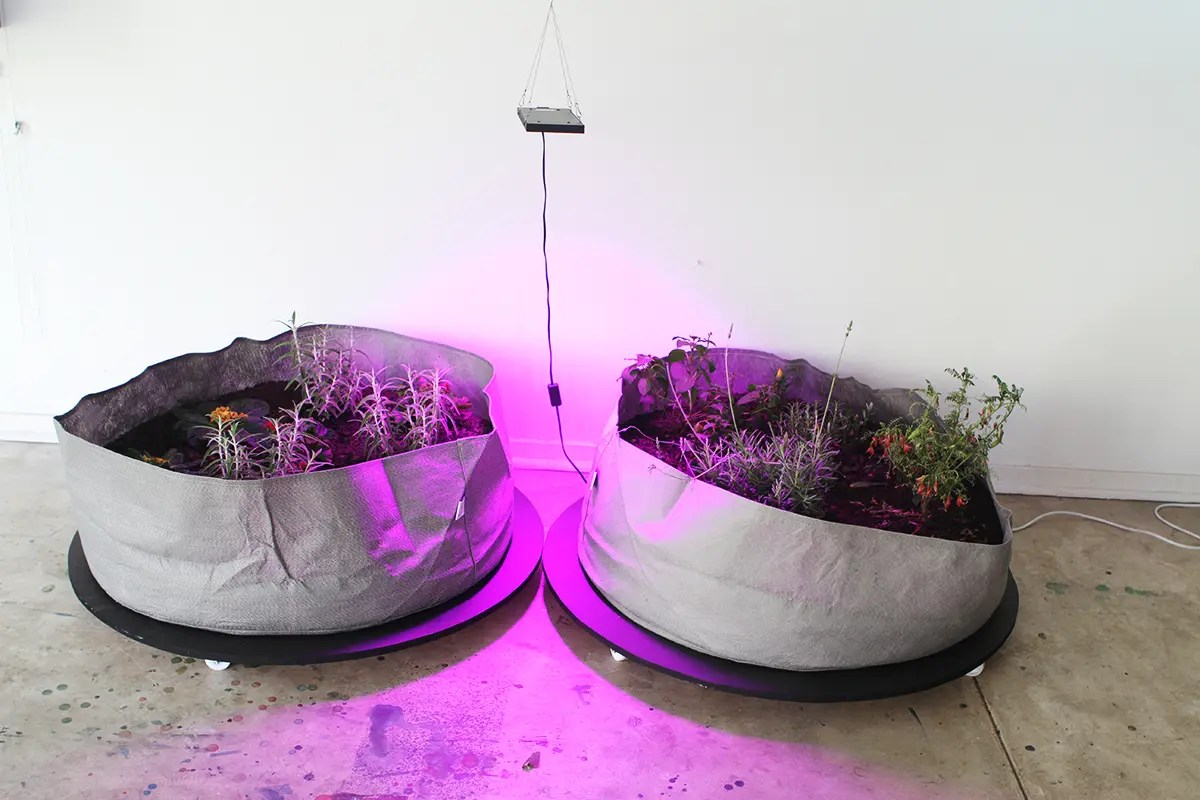
You are already inside this & Natures Apothecary
Consciousness as a word, was not yet born when Milton wrote:The mind is its own place, and in it ‘self’ can make a ‘Heaven of Hell, a Hell of Heaven’
This philosophical interest naturally evolved towards climate change and ecology challenges supported by secondary research sources. My artwork is motivated by personal feelings I have felt and experienced over this decade when I have experienced extreme weather events in our Southern African region. The current La Nina, Pacific Ocean weather pattern has increased floods and cyclones. In the previous El Nino pattern, we experienced extreme water shortages in our cities due to extended drought conditions and apocalyptic wildfires in the Western Cape province.
Antonio Damasio writes in his book, ‘Feeling and Knowing: making minds conscious’ that, “The power of feelings comes from the fact that they are present in the conscious mind: technically speaking, we feel because the mind is conscious, and we are conscious because there are feelings…Feelings were and are at the beginning of an adventure called consciousness.”
I understand his model of ‘consciousness’ as an antidote to the hubris with which humanity regards itself and other life forms..the hubris of human exceptionalism across species, which presumes that our superior cognitive capacity relative to other animals means greater consciousness.
Environmental philosopher Val Plumwood suggests; “prevailing western culture has created a human – nature dualism – in this world view, nature is radically different from the human and human culture is radically separated from it.”
McKibben (1990) writes “Over the last century, human life has become a machine for burning petroleum. Humans have lived for thousands of years pyrotechnically. They have been burning, melting, mixing inanimate materials such as coal and iron, resulting in what can only be called runaway fossil fuel consumption.“
Biologist John De Long explains that power (defined as the rate of energy transfer) is key to the survival and success of species.
Our species has gained unprecedented power by harnessing the energy of fossil fuels. All stuff made by man now outweighs all of Earth’s biomass. It’s been the biggest grab on this planet, and we even have a name for it.
THE ANTHROPOCENE.
Timothy Morton writes in his book, ‘Hyper objects – philosophy and ecology after the end of the world‘ global warming is the most dramatic example of hyper objects. He says they are; “entities of such vast temporal and spatial dimensions that they defeat traditional ideas about what a thing is in the first place. You cannot ‘see’ global warming. You only see snapshots of what is a very complex plot of a superset of algorithms that is executing themselves in high dimensional phase space.”
Morton argues that hyper objects show that the end of the world has already occurred in the sense that concepts such as world, nature, and even environment are no longer a meaningful horizon against which human events take place. Instead of inhabiting a world, we find ourselves inside several hyper objects, such as climate, nuclear weapons, evolution, or relativity. They are profoundly futural and last for a hundred thousand years. The ruptures are the invisible presence of the hyper object itself, which looms around us constantly, making hypocrites of us all.
-
A different kind of fire
Biologist David George Haskell writes..
We are all – trees, humans, insects,birds,bacteria – pluralities. Life is embodied network. These living networks are not places of omnibenevolent oneness. Instead they are where ecological and evolutionary tensions between cooperation and conflict are negotiated and resolved.’
This series, ‘A different kind of fire’ (2021), is inspired by Biologist Haskells statement and reflects on current scientific secondary research around increased temperatures, and its effect on oceans, coral reefs, forests, extreme floods, droughts and wildfires, mass internal and external migration influenced by these changes, and the use of single use plastic that is choking our environment.
We are living in the ‘Anthropocene’ age, where human activity dominates and tries to control nature, losing sight as field Ecologist Dr Stephen Woodley suggests…’We are part of nature and we do not exist without it..if Biodiversity disappears, so do people’
-
Nothing stands still
Heraclitus, the ancient Greek Philosopher, wrote a treatise entitled ‘About Nature’, in which appears an aphorism as ‘the whole flows as a river’ or figuratively, as ‘everything flows, nothing stands still’
This portfolio of artwork reflects on ‘belonging’, ‘migration and refugees’, aligned to the theme of Water, as the underlying conceptual metaphor for this reflection – Fresh Water as a limited natural resource.
Today ungoverned migration is threatening geopolitical stability, burdening border controls and creating chaos around the world, Governments are preoccupied with deterring migration and restricting peoples movement, this obsession with control has had little impact on irregular migration flows, because it runs counter to the pull of market forces and the push of personal aspirations. (ie ‘becoming’)
Irregular migration flows, such as the Syrian and Sudanese wars, resulting in massive refugee displacements crisis, brings to our collective consciousness, the questions of place and belonging, the question of nationality, who belongs where and why, and who is allowed in or not, who controls ownership, access, and pricing to natural resources such as freshwater, who gets to decide where you can find refuge, especially when, where you live, were born, can no longer sustain harmonious life.
Worldwide more than 60 million people have been displaced by Climate Change, war, persecution or human rights abuses.
What is our collective moral and legal obligations, to refugees fleeing from war or people migrating from economic scarcity or political oppression, or specifically in this reflection, searching for a natural resource such as fresh water?
The cyclical drought experienced in our Southern African region brought on by the recent El Nina climate effect brings to mind, where do people go when there is no longer fresh water easily available?
Following my Portfolio over the last 3 years, addressing the human condition around the philosophical big question of being, consciousness, and ultimately death, my current work focuses on ‘Water’, as a metaphor for responding philosophically to these thoughts and questions.
Clean, accessible water is an essential part of life and an important natural resource to manage, as 1 Billion humans globally have no access to clean water, effectively 1 in 10 people. The harsh truth being 2.5% is Freshwater and less than 1% is really accessible.
It is not a Limitless and Free resource as perceived mostly where there is no apparent scarcity.
Water co-operation and the lack of it already underpins many Transboundary conflicts. Unesco and Green Cross International joined forces with a programme to promote peace, in response to the growing threat of conflicts linked to water. Global drying is believed to be one of the causes of bloodshed in Somalia, Sudan & Syria.
Added to this, icecaps are melting. Sea levels have always been influenced by climatic shifts, changes to coastlines, volcanic eruptions, but more and more Scientific studies are suggesting that we have never seen anything like the rate of change as witnessed today.
Changing precipitation and melting snow and ice are altering hydrological systems, glaciers are shrinking worldwide and the result is that more and more people and nations will have to compete for resources.
In the Venice Biennale ‘ Viva arte’ 2017, the curator Macel suggested that the overall exhibition intended to operate a few steps removed from current, political landscapes, it is in her curatorial view, the radical proposition that humans should be defined not by arbitrary national borders but by shared experiences.
My reflection further supports her idea metaphorically as water flows, so life flows and it further supports that sheltering and supporting people fleeing from bombs, bullets, torture, rape, necessity is not an act of ‘charity’, it is a legal and moral obligation prescribed by International law and by our common humanity.
From this reflection, enquiry into the current global political landscape and Water as a metaphor, this work, focuses largely on the colour/ tone Blue and introduces photographic images taken with my i-phone in Iceland, into my painting and printmaking practice.
The J.Paul Getty Museum, recently exhibited ‘What does Blue mean? 2017, where they explore the science and sentiment of the colour blue, suggesting that ‘Blue is perhaps, the most poignant colour’. From Picasso’s blue period to Tennessee Williams ‘blue roses’ to the Mississippi Delta blues, the fifth hue on Newtons centuries – old colour wheel, has come to convey depth, sadness and yearning.
This body off work is drawn to the unconscious mind influenced by philosophical ideas – embracing the element of chance in my paintings, allowing the paint too flow as water flows and consciously and purposely challenging my practice away from traditional figurative representation as far as possible, using words and photographic images captured, as a means off examining, the idea off ‘facelessness’, ‘no identity’, thereby attempting to objectify the crisis, off mass refugees and migration.
-
Denial of Death
Interested in themes around ‘Human Consciousness”, what It’s really like to be conscious from a philosophical Existentialist point of view. Existential questions that all of us grapple with in some way or other,that have no concrete concurrent universal answers. This theme is a response to various philosophical thoughts, that explores the conscious reflection of ‘death’ and of our ‘denial’ as ‘conscious thinking’ human beings thereof.
Ernest Becker’s philosophy was the first,that brought death and dying out of the closet. It is based on four strands:
The first that “ Mother Nature is a brutal bitch, red in tooth and claw, who destroys what she creates. We live, he says, in a creation in which the routine activity for organisms is ‘tearing others apart with teeth of all types – biting, grinding flesh, plant stalks, bones between molars, pushing the pulp greedily down the gullet with delight, incorporating its essence into one’s own organization, and then excreting with foul stench and gasses the residue”.
The second strand : The basic motivation for human behavior is our biological need to control our basic anxiety, to deny the terror of death. Human beings are naturally anxious because we are ultimately helpless and abandoned in a world where we are fated to die. “This is the terror: to have emerged from nothing, to have a name, consciousness of self, deep inner feelings, an excrutiating inner yearning for life and self expression – and with all this yet to die”
The third: Since the terror of death is so overwhelming we conspire to keep it unconscious. Every child borrows power from adults and creates a personality by interjecting the qualities of the godlike being. I. e If I am like my all powerful father I will not die.
The fourth strand: Our heroic projects that are aimed at destroying evil have the paradoxical effect of bringing more evil into the world. The root of humanely evil is not mans animal nature, not territorial aggression or innate selfishness, but our need to gain self – esteem, deny our mortality, and achieve a heroic self image.
In the science of man, Otto Rank, brought the existential paradox of man i.e the fear of life and the fear of death, into prominence – Man is a worm, and food for worms. This is the paradox; he is out of nature and hopelessly in it; he is dual, up in the stars and yet housed in a heart pumping, breath-gasping body that once belonged to a fish and still carries the gill-marks to prove it. His body is a material fleshy casing that is alien to him in many ways – the strangest and most repungnant way being that it aches and bleedes and will decay and die. Man is literally split in two; he has an awareness of his own splendid uniqueness in that he sticks out of nature with a towering majesty, and yet he goes back into the ground a few feet in order blindly and dumbly to rot and disappear forever.
Heidegger brought these fears to the center of existential philosophy. He argued that the basic anxiety of man is anxiety about being-in-the-world, as well as anxiety of being-in-the-world
The Theologian Soren Kierkegaard’s view was that man is a union of opposites, of self-consciousness and of physical body. Man emerged from the instinctive thoughtless action of the lower animals and came to reflect on his condition. He was given a consciousness of his individuality and his part-divinity in creation, the beauty and uniqueness of his face and his name. At the same time he was given the consciousness of the terror of the world and of his own death and decay. This paradox is the really constant thing about man in all periods of history and society.
Rank believed that the Consciousness of death is the primary repression which is the crucial concept that makes man creaturely. This is the repression on which culture is built, a repression unique to the self conscious animal.
-
What is it like?
Thomas Nagel in 1974, famously asked… “ What is it like to be a bat? ”
I explore the so called “hard problem” of consciousness, the “Conscious Self”, addressing the subjective quality of experience i.e the raw feelings associated with our mental lives, in philosophical terms, its “qualia”.
Neuroscientists Francis Crick and Christof Koch have expounded on this, i.e ‘the difficulty to relate electrochemical activity in the brain, the nervous system and and sensory organs to “what it is like”, to have an experience, see the redness of red, the painfulness of pain, the stabbing cramp of hunger, the pangs of jealousy and so on. From this, I ask “what is it like to be woman?”
To fully explore the subjective quality of experience, I draw within myself as the “object”, the body that makes up part of my Identity, understanding that Identity cannot float free from the physical, but am of the view that our ‘consciousness’, that it is not in our physical bodies, that we find the pearl of self. Our sense of self, is rooted in what we think and how we feel. The question, what is it like to be woman, stemming from my own consciousness in experience.
Underlying this exploration, I draw on various postmodern philosophical and sociological views on the “Philosophy of the Mind” and Readings by Philosopher, Simone de Beauvoir in “The second Sex”
-
Following the Red Light
Explores collective consciousness, memory and emotion, reflecting on the effects of globalization, largely through mass communications, social media platforms and mobile applications, and their capacity to bring psychological pressures and the uncontrolled complexity of their power to influence us. It can be argued, we are becoming a universal simplified human being, giving birth to a binary mind that is increasingly devoid of complex ideas, nuances and easily convinced of the truths it is told again and again, leading to the current globalized era of ‘politics of emotion’.
The brain is complex, and not fully scientifically understood. Our consciousness is accepted by most of us as given by our “being alive and here”, yet we do not fully understand it. We behave, act in a social, cultural context, based on the Information our brains receive, store and retrieve. We make daily decisions based on how we feel, think, believe, fed by the stimulus we receive, and how our memory retrieves it. Our emotions are impulsive, instinctive and unpredictable, based on how we retrieve, internalise stimulus and information.
 Tessa Teixeira